What Is the Best Custom Shirt Printing Method for Your Logo
Before the First Squeegee Pull Setting the Stage for Your Perfect Logo Print
Your logo sits at the intersection of your brand promise and customer perception. Every color, curve, and placement decision carries weight that extends far beyond a simple graphic. We see business owners agonize over this choice every day at our Commack print shop. The right printing method transforms your logo into a walking billboard that people trust. The wrong one leaves you with a box of shirts nobody wants to wear.
Why Your Logo Is Not Just Another Graphic
Your logo carries years of late nights, customer feedback, and brand refinement inside its simple shape. Treating it like clip art overlooks the emotional connection your customers have built with that mark. We have watched small businesses grow into Suffolk County staples simply because their logo appeared consistently on quality apparel. When someone sees your logo on a well-printed shirt, they subconsciously assign value to your entire operation. That value evaporates instantly if the print cracks, fades, or feels like a plastic sticker. Your logo deserves printing that respects the journey it represents. Every time we handle artwork at custom logo shirt printing services Long Island, we treat that file like the business asset it truly is. Your logo is the visual handshake you never get to deliver in person.
A logo printed poorly sends a message you never intended to send. Customers interpret a peeling print as a company that cuts corners everywhere. They see fuzzy details and assume your attention to quality stops at the surface. The opposite also holds true when execution matches intention perfectly. A crisp embroidered logo on a polo suggests precision and reliability before you speak a single word. We counsel clients to think of their logo as the ambassador that arrives ahead of them. That ambassador needs proper attire for the job you are asking it to do.
The Moment of Truth When a Bad Print Undermines Your Brand
Picture your sales team walking into a client meeting wearing shirts where the logo already shows cracking after three washes. That awkward moment registers with prospects even when nobody mentions it aloud. We hear stories from business owners who learned this lesson the hard way after ordering from discount online fulfillers. The cheap price evaporated the instant they saw their brand represented by peeling ink and crooked placement. Your logo printed poorly tells everyone you accepted mediocrity somewhere along the line. Quality printing signals that you care about details from production through customer service.
The wash test separates professional printing from the stuff that falls apart. Real screen printing with proper cure temperatures anchors ink into fabric fibers permanently. Our water-based inks bond at the molecular level rather than sitting on top like a decal. A bad heat transfer will start lifting at the edges after a handful of laundry cycles. Direct-to-film that was not properly cured creates the same disappointing result. You need a print shop that runs its own machines and understands the chemistry behind every ink deposit. Third-party fulfillers simply cannot match the accountability of a local Commack printer who stands behind every order.
What This Guide Will Uncover About Logo Printing Methods
This article walks you through every major method available for putting your logo on apparel. We will cover screen printing on our M&R Gauntlet presses for bulk business orders. You will learn when direct-to-garment on the Brother GTX Pro makes sense for photographic detail. Embroidery versus screen printing gets addressed head-on so left chest logos get matched to the right process. Direct-to-film and heat transfer applications each have specific scenarios where they outperform everything else. By the final section, you will understand exactly which method fits your logo, your order size, and your deadline. We are pulling back the curtain on the trade-offs pros weigh every single day.
We will also dig into the invisible steps that determine final quality. Logo digitizing for embroidery and vector art conversion happen before any thread touches fabric. Pantone color matching ensures your brand red stays consistent across t-shirts, hoodies, and caps ordered months apart. Mockup proofs let you see your logo on a shirt before we commit ink to garment. This is not a surface-level overview written by someone who has never pulled a squeegee. This comes from a team that prints thousands of logos every month for businesses across Long Island. You will leave with the knowledge to make the single best decision for your brand.
Your Logo’s Blueprint How Complexity Colorways and Fabric Weave the Rules
Your logo file dictates more about your printing options than most people realize. A simple one-color design with bold shapes opens doors to virtually every method available. Complex gradients with photographic elements immediately narrow your viable choices to DTG or well-executed DTF. We ask for vector files because they make screen printing separations clean and embroidery digitizing precise. Raster images at low resolution force us into methods that can mask pixelation rather than celebrate your original design. Understanding these connections before you order saves frustration and unexpected costs down the road.
Fine Detail Logo Reproduction Why Hairline Strokes Need More Than Just Any Ink
Thin lines and small text push printing equipment to its absolute limits. Screen printing demands that we adjust mesh counts carefully when your logo contains hairlines thinner than a single point. Our 230 and 305 mesh screens capture delicate strokes that lower mesh counts simply cannot resolve. Ink viscosity matters immensely here because overly thick ink will bridge across fine details and blur your sharp edges. Direct-to-garment printing on the Brother GTX Pro handles fine detail beautifully with its precision print head technology. Embroidery presents the biggest challenge for tiny elements since thread has physical thickness that cannot shrink below 40wt polyester limitations.
We often recommend thickening key logo elements slightly when clients want embroidery for super fine artwork. A minimum stroke weight of 0.5 points keeps details legible in thread where anything thinner disappears into fabric texture. The substrate itself works against you when tiny details hit the weave of a cotton t-shirt. Ringspun cotton provides a smoother canvas than open-end carded cotton for fine detail reproduction. This is why we discuss fabric choices alongside printing method selection. Your logo might look perfect on paper but needs specific production choices to translate that precision to apparel. Trust our team to flag potential detail problems before they become printed disappointments.
Pantone Color Matching Your Brand’s Red Must Stay Your Red Every Single Batch
Color consistency separates professional logo reproduction from amateur approximation. The Pantone Matching System gives us a universal language for color that eliminates guesswork across production runs. Our spectrophotometer reads color precisely and calibrates our ink mixing to hit your specified Pantone within a tight tolerance. Screen printing shines here because we mix custom ink colors that match your brand guidelines perfectly. DTG printing approximates Pantone through process color mixing which works well but cannot achieve the exact spot color accuracy of plastisol or water-based ink mixed manually.
We maintain color records for every repeat client so their March order matches their September reorder without drift. This matters enormously for corporate logo apparel programs where multiple departments order across different seasons. The underbase color also shifts final appearance dramatically on dark garments. White underbases create a bright, opaque foundation but can slightly cool down warm tones if not properly calibrated. Our press operators adjust for these interactions on every single run. We treat your brand color as sacred because we know your customers notice when that signature blue looks slightly purple on the latest batch of shirts. Consistent color builds brand trust one correctly printed shirt at a time.
The Dark Garment Underbase Dilemma How a White 110 Mesh Screen Saves Your Logo
Printing a bright logo on a black shirt requires foundational steps that light garments skip entirely. White ink must lay down first as an underbase that creates opacity for colors printed on top. We use a 110 mesh screen for this white layer because it deposits enough ink to block the dark fabric from showing through. The white layer gets flash cured before color screens print on top in perfect registration. Without this step, your vibrant logo turns muddy as the black cotton absorbs and darkens every translucent ink deposit. This is non-negotiable for professional results on any garment darker than a heather gray.
The underbase adds cost and complexity but separates acceptable results from truly professional logo reproduction. Bleed resistance becomes critical because white ink wants to migrate into dark polyester fibers under heat. Our low-bleed inks and precise temperature control prevent that ghostly white haze from appearing around your logo edges. DTG handles dark garments differently by pretreating the fabric and printing white ink directly through the printer before color layers follow. Each method approaches the same fundamental challenge from a different technical angle. Understanding this underbase reality explains why dark shirt printing costs more than light shirt printing across every method available. The extra step demands extra time, material, and operator skill to execute correctly.
Water Based Ink Softness The OEKO TEX Certified Feel That Customers Notice
People touch their shirts constantly and they judge print feel without even realizing it. Heavy plastisol prints feel like a plastic patch sitting on the fabric surface. Water-based ink actually penetrates cotton fibers and dyes them directly, leaving virtually no hand feel at all. Our OEKO-TEX Standard 100 certified water-based inks meet rigorous safety standards for substances that contact human skin. This certification matters for children’s apparel, baby onesies, and anyone with sensitive skin concerns. The ink becomes part of the shirt rather than a foreign layer attached to the outside.
Soft-feel prints get worn more often and that increases your brand impressions every single time. A comfortable logo shirt becomes someone’s favorite weekend tee rather than the stiff promotional item buried in the back of the closet. Water-based ink also ages gracefully because it cannot crack like thick plastisol deposits. The shirt eventually fades but the print fades right along with it naturally. We recommend water-based discharge printing for fashion-forward brands that prioritize premium feel above maximum opacity. The trade-off comes in color vibrancy on dark garments where water-based struggles to match plastisol brightness. Each choice balances priorities and we walk you through those decisions before committing to production.
Logo Placement on Hoodies Polos and Seamed Apparel When Standard Centers Go Awry
Full-front chest placement works beautifully on t-shirts but hoodies introduce complications nobody anticipates. That front pouch pocket interrupts the printable area and forces logo placement either above or below the seam line. Zipper hoodies create even more constraints because the center splits apart when worn open. Left chest logos on polo shirts must account for the placket and buttons that occupy prime real estate. We position embroidery or print slightly inside the placket edge rather than dead center on the garment body. These adjustments require experience rather than a rigid template applied blindly to every garment style.
Seamed apparel like raglan sleeves or side-seam tanks further complicates standard logo positioning. Three-quarter sleeve baseball tees look amazing with logos but the raglan seam demands a slightly higher placement to balance visually. Youth shirts need scaled-down logo sizes because a full adult left chest print overwhelms a toddler tee. We keep a sizing chart that adjusts logo dimensions across garment styles and sizes automatically. Every order receives placement review before production so your logo lands exactly where it should every single time. Custom shirt printing demands this level of attention because generic placement looks generic and your brand deserves better.
Behind the Machine The Real Differences Between Screen Printing DTG Embroidery DTF and Heat Transfers for Logos
Five major methods dominate custom logo printing and each one solves specific problems exceptionally well. Screen printing remains the workhorse for bulk orders where cost per print and durability matter most. Direct-to-garment opens photographic detail and full color without setup fees for small quantities. Embroidery brings texture and permanence that no flat print can replicate for professional apparel. Direct-to-film bridges the gap for tricky fabrics and full-color small runs that screen printing cannot serve economically. Heat transfer vinyl delivers fast personalization for names and numbers on team uniforms. Choosing wrong wastes money either through excessive setup costs or through prints that fail prematurely in the wash.
Screen Printing for Business Logos Using M R Gauntlet Presses and Halftones for Big Runs
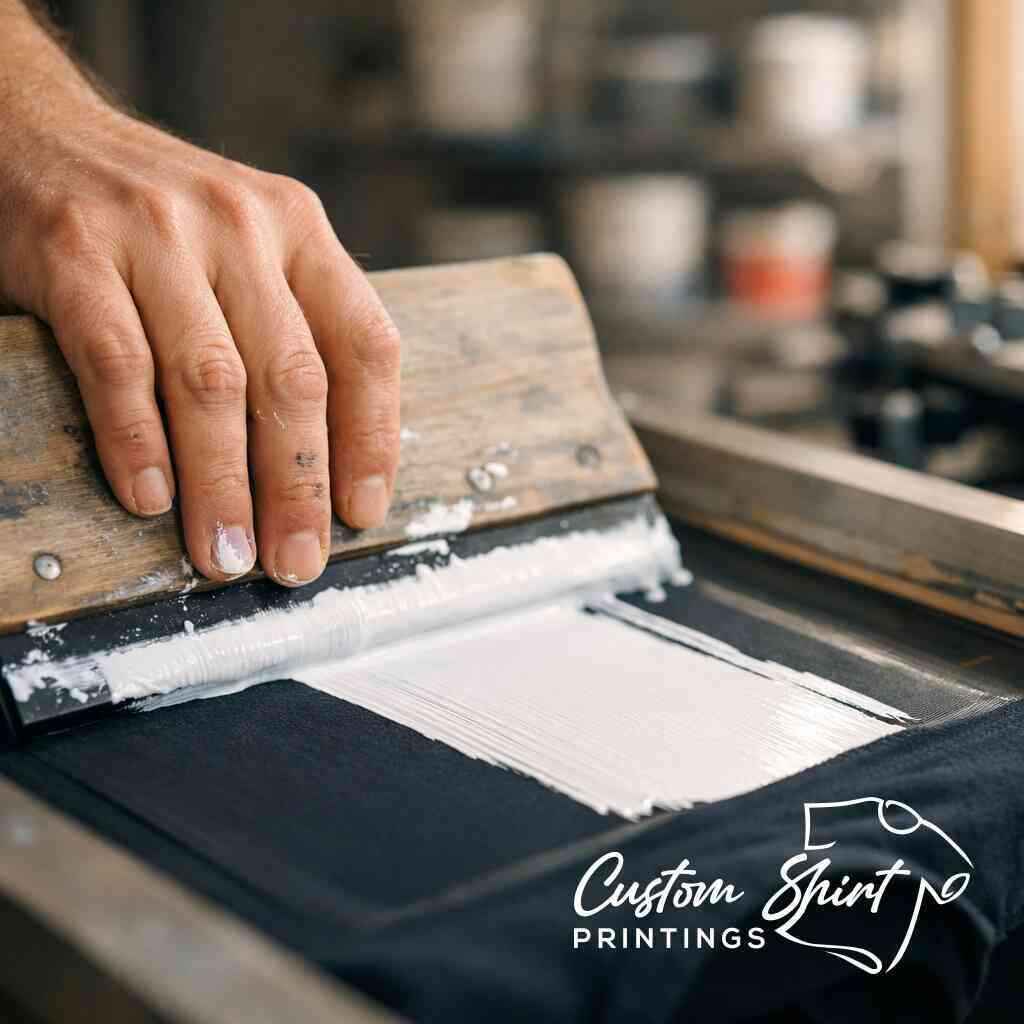
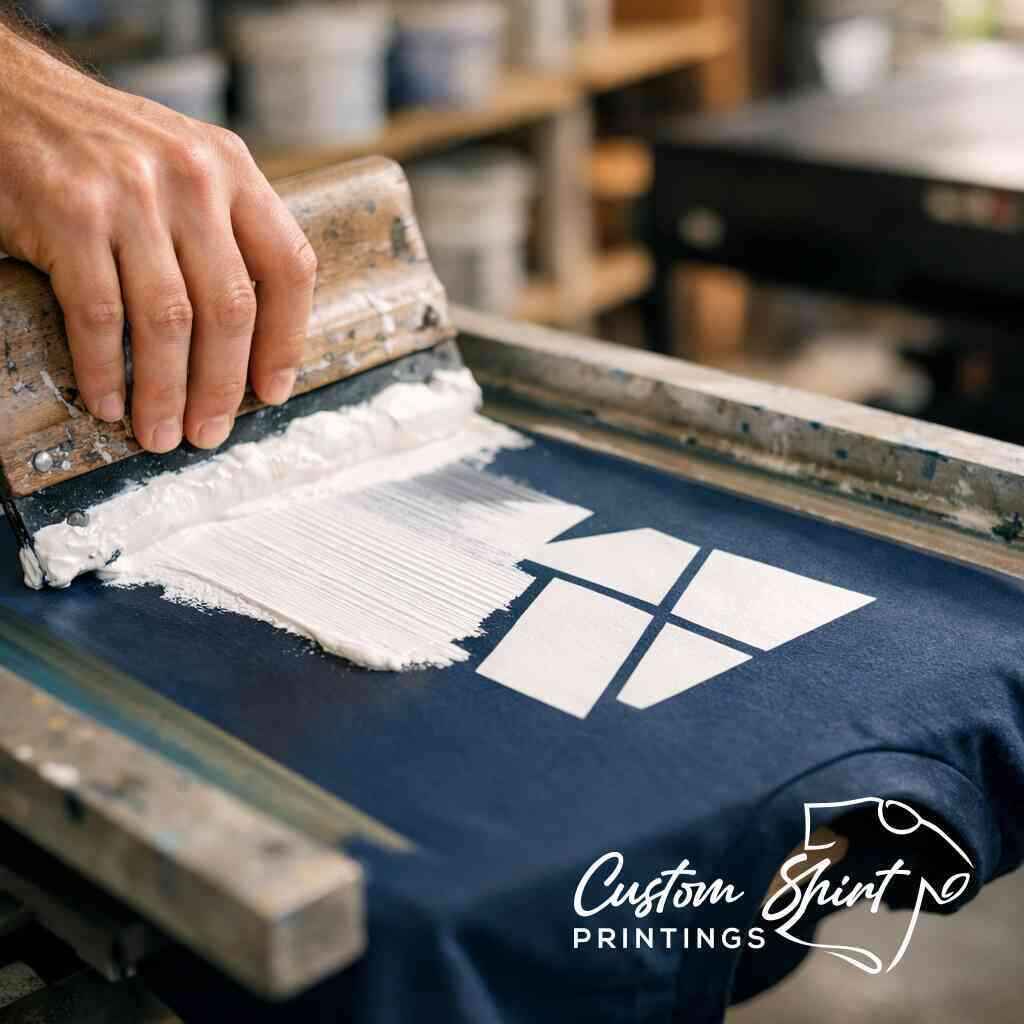
Our M&R Gauntlet automatic press runs twelve colors simultaneously with registration so tight you cannot slip a fingernail between colors. Screen printing creates the most durable logo application available because plastisol and water-based inks cure into the fabric structure permanently. Halftone techniques let us simulate gradients and photographic elements using dots of solid color rather than true process printing. This keeps screen count manageable while still delivering impressive detail for logos that push beyond simple spot colors. The setup cost per screen makes sense as order quantities climb because that fixed cost spreads across more units. Screen printing for business logos Commack NY delivers the lowest cost per print once you hit around 72 pieces.
Ink opacity leads the list of screen printing advantages for logo reproduction. Plastisol white prints bright and solid on black garments in a way that DTG struggles to match consistently. You can feel confident wearing a screen printed logo shirt for years without seeing significant degradation. The ink forms a mechanical bond with cotton fibers during the curing process at 320 degrees Fahrenheit. Properly cured plastisol survives industrial laundering and stays bright through hundreds of wash cycles. We print thousands of business logo shirts monthly on our Gauntlet and can count the failure rate on one hand.
Direct to Garment Logo Printing on the Brother GTX Pro When Photographic Detail Wins Every Time
The Brother GTX Pro printer uses inkjet technology to apply water-based pigment ink directly onto pretreated fabric. Photographic logos with gradients, shadows, and unlimited colors print beautifully because there are no screen limitations to work around. This method excels when your logo includes a photograph of a product, a person, or a complex illustrated scene. Setup costs approach zero because the printer reads your digital file and prints it directly without screens or films. Small orders become economically viable since you avoid paying for screen setup on a dozen shirts. Direct to garment logo printing on Long Island gives startups and small businesses access to full-color logo reproduction that used to require massive bulk orders.
DTG prints feel exceptionally soft because the water-based ink penetrates cotton fibers rather than sitting on top. Pretreatment prepares dark garments to receive white ink as a base before color layers print above. The wash durability on DTG has improved dramatically with modern ink formulations and proper curing protocols. We follow ASTM D5264 standards for wash-fastness testing on our production samples to verify quality. The limitation comes in opacity on dark garments where even the best DTG cannot fully match plastisol screen printing brightness. For photographic detail on light garments though, nothing else comes close to DTG precision at any quantity.
Embroidery vs Screen Printing Logos Why Left Chest Logos Often Favor Needle and Thread
Embroidery adds dimension and perceived value that flat printing cannot approach for professional garments. A left chest logo embroidered on a polo shirt communicates permanence and quality before anyone reads a single word. Thread reflects light differently than ink creating a premium look that suits corporate apparel, golf shirts, and executive gifts. We use Madeira Polyneon 40wt polyester thread that withstands industrial laundering and maintains color vibrancy for years. The embroidered logo becomes physically part of the garment structure rather than a surface application that might fail. For polos and button-down shirts, embroidery wins almost every comparison against screen printing.
The trade-off arrives in detail reproduction where thread thickness limits how fine you can go. Tiny text under a quarter inch becomes illegible in thread where screen printing renders it perfectly. Complex gradients disappear because embroidery reduces artwork to solid thread colors with limited shading options. Screen printing vs embroidery for logos comparison ultimately depends on your logo complexity and garment type. We recommend embroidery for simple bold logos on professional apparel and screen printing for detailed artwork on casual t-shirts. Some clients use both methods across their apparel program depending on the specific garment and use case.
Logo Digitizing and Vector Art Conversion The Invisible Step That Makes Embroidery Sharp
Embroidery machines cannot read your JPG or PNG logo file directly. Every design needs conversion into a stitch file that tells the machine exactly where to place each needle penetration. This digitizing process determines thread density, stitch direction, underlay structure, and color sequence for your logo. Poor digitizing produces gaps between colors, distorted shapes, and logos that pucker the fabric around the edges. Professional digitizers understand how thread pulls fabric and adjust stitch angles to compensate for material stretch. We work with logo vector art conversion service for shirt printing partners who specialize in translating graphic design into embroidery reality.
Vector art provides the cleanest starting point for digitizing because paths convert directly to stitch coordinates. Raster art requires manual tracing which introduces interpretation errors and extends turnaround time. The digitizer chooses stitch types strategically with satin stitches for lettering edges and fill stitches for larger solid areas. Underlay stitches lay down first to stabilize the fabric before the visible thread layers follow on top. This invisible foundation prevents shifting during the embroidery process and keeps your logo registration perfect. Great digitizing makes the difference between an embroidered logo that looks professional and one that looks like a failed craft project. We never skip this step because it determines the entire outcome.
Direct to Film Logo Applications Full Color on Any Fabric Without Pretreatment Hassles
Direct-to-film prints your logo onto a special PET film with adhesive powder applied before heat transfer to the garment. The result delivers full color with excellent opacity on cotton, polyester, blends, and even nylon that DTG cannot handle. DTF eliminates the pretreatment step that DTG requires for dark garments saving production time on every order. The film prints in reverse on our dedicated printer then gets powdered, cured, and heat pressed onto your shirt. Colors pop vividly because the white underbase prints as part of the film construction rather than requiring separate garment preparation. Direct to film logo printing on custom tees opens possibilities for fabric types that limit other printing methods.
DTF fills the gap between screen printing bulk economics and DTG fabric limitations with impressive versatility. The hand feel is slightly heavier than water-based prints but thinner than traditional vinyl heat transfers. Durability matches or exceeds DTG when properly applied with correct temperature, pressure, and dwell time settings. Polyester performance wear accepts DTF without the dye migration issues that plague plastisol on synthetic fabrics. This makes DTF the go-to choice for sports jerseys and moisture-wicking team uniforms. The method handles small runs economically because setup involves only the film print rather than screen preparation. For a dozen performance polos with full-color logos, DTF often beats every alternative on quality and speed.
Heat Transfer Logo Quality Small Runs and Quick Names with Vinyl That Sticks
Heat transfer vinyl cuts individual names, numbers, and simple logos from solid color sheets of polyurethane material. We use Siser EasyWeed vinyl that adheres reliably to cotton, polyester, and blended fabrics with consistent peel characteristics. The process requires weeding excess material around your design by hand before heat pressing onto the garment. HTV excels for personalization runs where every shirt needs a different name or number applied quickly. Team jerseys with player names and numbers represent the classic heat transfer vinyl application. The material sits on top of the fabric like a thin flexible film rather than penetrating fibers.
Simple one-color logos work well with HTV because each color requires a separate cut and press application. Multi-color designs quickly become labor-intensive and alignment between layers challenges even experienced operators. HTV durability has improved dramatically with modern polyurethane formulations that withstand washing better than old PVC materials. We still recommend avoiding fabric softener and high heat drying to maximize heat transfer lifespan. For quick turnaround projects with variable personalization, HTV solves problems that stymie every other decoration method. Nothing beats heat transfer vinyl when you need ten different names on ten shirts ready tomorrow morning.
Where Your Logo Lives in the Real World Order Size Deadlines and Budget Reality
The perfect printing method only matters if it aligns with your actual order parameters. A screen printing setup that costs fifty dollars in screen fees looks painful on a twelve-shirt order but disappears into pennies per shirt at five hundred pieces. DTG prints beautifully at any quantity but carries a flat per-print cost that never benefits from bulk economies. Rush deadlines eliminate methods that require extended setup or curing time regardless of how well they suit your logo. You need the method that balances quality, quantity, and timeline for your specific situation. We help you navigate these trade-offs honestly because long-term relationships matter more than maximizing a single order.
Cost Per Print for Logo Shirts The Math That Favors Screen Printing at 72 Pieces and Up
Screen printing setup costs cover screen creation, ink mixing, and press registration for each color in your logo. A three-color logo requires three screens that cost around twenty-five dollars each to prepare. Those seventy-five dollars in setup sting on a twenty-shirt order where they add nearly four dollars per shirt before ink and garment costs. The same setup on three hundred shirts drops to twenty-five cents per shirt and screen printing suddenly becomes dramatically cheaper than DTG. We calculate cost per print for logo shirts screen printing vs DTG honestly for every quote we generate. The breakpoint typically lands around seventy-two pieces where screen printing economics overtake DTG for most standard designs.
DTG costs remain steady regardless of quantity because no physical setup exists beyond loading the shirt onto the platen. This makes DTG the clear winner for orders under fifty pieces where screen setup fees dominate total cost. Embroidery pricing follows a stitch count model where logo complexity drives cost more than quantity. A dense embroidered logo with ten thousand stitches costs more than a simple text logo regardless of how many polos you order. Direct-to-film occupies a middle ground with film creation costs that spread across moderate quantities effectively. Understanding these cost structures prevents sticker shock and helps you budget accurately for every apparel project.
No Minimum Custom Logo Shirts How You Can Print One Tee for Your Startup Pitch
Many print shops enforce minimum order quantities that block small businesses and startups from accessing professional logo printing. We eliminated minimums because we believe every business deserves professional branding from day one. DTG printing makes single-shirt orders possible without sacrificing print quality or color accuracy. Custom logo printing methods overview at our Commack shop includes DTG specifically to serve entrepreneurs launching their first venture. You can order one shirt with your prototype logo to test market response before committing to bulk inventory.
Direct-to-film also handles single pieces beautifully for certain applications where DTG falls short on fabric type. Embroidery minimums stay low because modern machines change thread colors automatically rather than requiring manual rethreading between colors. We understand that ordering custom apparel for the first time feels intimidating when you do not know what to expect. Our team walks you through every decision without pressure toward larger orders than you actually need. Start with one shirt if that makes sense for your situation. The relationship matters more than the initial order size.
Rush Logo Shirt Turnaround Our Commack NY Presses Cut Out Third Party Fulfiller Delays
Online ordering platforms that farm printing to third-party fulfillers introduce delays you cannot control or predict. Your rush order sits in a queue behind thousands of other orders at a facility that does not know your name. Our presses run at 1139-7 Jericho Turnpike in Commack where we control production scheduling directly. The Brother GTX Pro prints DTG orders same-day for small quantities without waiting for screen preparation. Rush orders get assigned to specific production slots rather than disappearing into an automated fulfillment pipeline. We deliver rush logo shirts to Suffolk County businesses faster because we eliminate the middleman entirely.
Screen printing rush orders require screen preparation time that we compress by pulling screens from our extensive library of repeat client designs. Returning clients who need fifty more shirts with their existing logo skip the screen creation step completely. Direct-to-film rush orders move from art approval to heat press application within hours for small quantities. Embroidery rush service depends on digitizing status with existing digitized logos producing same-day or next-day. We tell you honest timelines rather than overpromising to close the sale and underdelivering when it counts. Local custom logo shirts Commack production means accountability sits in one building with people who answer the phone.
Corporate Logo Apparel Programs Why Bulk Screen Printing Locks in Brand Consistency Year Round
Companies with multiple departments ordering branded apparel need consistency across every garment and every order. Screen printing locks in your exact Pantone ink formulations so the marketing team polos match the warehouse crew t-shirts perfectly. We maintain your screens on file and your ink formulas documented so reorders reproduce your brand colors identically. Corporate logo apparel programs benefit from bulk screen printing discounts while maintaining the quality standard your brand requires. The setup investment pays off across months and years of consistent branded merchandise for every department that needs it.
Embroidered corporate polos follow the same consistency model with digitized files stored permanently in our system. The left chest logo on an executive polo matches the left chest on a service technician work shirt every time. We can inventory blank garments for corporate clients who want just-in-time decoration without warehousing finished goods. This keeps your apparel fresh while still delivering fast turnaround when a department suddenly needs branded shirts for a trade show. Long-term corporate relationships get priority scheduling because we understand business apparel needs do not follow convenient timelines. Your brand consistency becomes our operational priority.
Mockup Proof Before Printing See Your Logo on a Tee Online Before We Ink a Single Thread
Nothing prevents disappointment like seeing exactly how your logo will look before production begins. Our custom shirt printing samples mockup proof process generates a digital rendering of your logo on your chosen garment. You approve placement, size, and color representation before any machine starts running. Changes at the mockup stage cost nothing beyond a few minutes of design adjustment. Changes after production cost real money and cause delays nobody wants to deal with. We insist on approval before printing because assumptions create mistakes and mistakes create unhappy customers.
The mockup shows your logo positioned correctly for the specific garment style you selected. Left chest on a polo appears differently than full front on a hoodie and the mockup reflects those differences accurately. Color representation on screen approximates final output but we note any limitations of monitor calibration versus physical ink. Physical samples remain available for large corporate orders where color accuracy demands absolute certainty before bulk production. The mockup proof step takes minutes but prevents problems that could waste hundreds of dollars in misprinted inventory. We consider this step mandatory rather than optional for every custom order regardless of size.
Putting Your Logo on the Right Thread A Final Word from Long Island’s Print Pros
You started this article wondering which printing method would serve your logo best. By now you understand that the answer depends on your specific combination of artwork, garment, quantity, and timeline. Screen printing delivers unmatched durability and cost efficiency for bulk orders above seventy-two pieces. DTG opens photographic detail and zero minimums for startups testing their brand. Embroidery adds premium texture and permanence for professional polos and corporate uniforms. DTF bridges tricky fabrics and full-color small runs that other methods struggle to serve. Heat transfer vinyl handles personalization at speed when every shirt needs different text applied.
The right method also depends on choosing a print partner who runs their own equipment and stands behind their work. Third-party fulfillers prioritize volume over quality because accountability disappears across the supply chain. Our Commack shop at 1139-7 Jericho Turnpike runs every process under one roof with experienced operators who care about your outcome. We have watched logos launch businesses, unify teams, and build community pride across Suffolk County and beyond.
Bringing It All Together One Logo One Method One Perfect Wearable
Your logo deserves the method that matches its complexity, your quantity, and how you want people to feel when they see it. A simple bold mark might shine brightest as embroidery on a crisp polo shirt. A photographic brand image needs DTG precision to capture every nuance. Bulk team orders make screen printing the obvious economic choice every time. You now possess the framework to evaluate these trade-offs with confidence rather than confusion.
We printed thousands of logos last year across every method described in this guide. The success stories share one common thread: matching method to logo rather than forcing a logo into a convenient production slot. Trust your understanding of the trade-offs and trust a print partner who explains them honestly. Your brand deserves wearing apparel that reflects the quality you deliver in your actual business.
Your Next Step Book a Free Logo Review at Our Commack Print Shop
Bring your logo file to our shop or upload it through our website for a free professional review. We will evaluate your artwork and recommend the specific method that delivers your best result. The recommendation considers every factor discussed in this guide including detail level, color requirements, garment selection, and order quantity. You walk away with clear pricing and realistic timelines without any obligation to proceed.
Visit us at 1139-7 Jericho Turnpike in Commack, New York 11725 to see our presses running and feel print samples firsthand. Our print shop serves businesses across Long Island and Suffolk County with custom apparel that makes brands look their absolute best. Let us put your logo on the right thread using the right method. You have invested too much in your brand to trust it to anything less than a printer who genuinely cares about getting it perfect.
Frequently Asked Questions
Question: What is the best custom shirt printing method for my logo if I need a small batch with photographic detail?
Answer: For small batches where your logo includes gradients, shadows, or photographic elements, direct to garment logo printing (DTG) is your ideal choice. At Custom Shirt Printings, our Brother GTX Pro printer uses water-based pigment inks to reproduce fine details and unlimited colors directly onto fabric. Unlike screen printing for business logos, which requires screen setup and bulk orders to be cost-effective, DTG has no setup fees, making it perfect for no minimum custom logo shirts. The ink penetrates the fibers for a soft feel and excellent wash durability. We serve local businesses right from our Commack NY shop, so you can get a free mockup proof before printing and fast turnaround on small orders.
Question: How do I keep my brand colors consistent across all my custom apparel, and what does Pantone color matching logo involve?
Answer: Consistent brand colors are crucial for professional corporate logo apparel programs. At Custom Shirt Printings, we use the Pantone Matching System and a spectrophotometer to mix custom inks for screen printing. This ensures your logo’s exact shade remains identical whether you order custom polo shirts, hoodies, or tote bags months apart. For screen printing for business logos, we mix plastisol or water-based ink manually to hit your specified Pantone. DTG approximates colors, but for critical spot colors, screen printing is superior. We maintain your ink formulas and screens on file for repeat orders. Our process includes a free mockup proof so you can approve the color before production. Trust our Long Island custom shirt printing team to keep your brand red truly your brand red.
Question: Which logo printing method lasts longest after many washes, and what is the best logo print durability I can expect?
Answer: The absolute best logo print durability comes from screen printing for business logos. When properly cured at 320°F on our M&R Gauntlet presses, plastisol ink forms a mechanical bond with the fabric that can withstand industrial laundering and hundreds of wash cycles without cracking or fading. Embroidery vs screen printing for logos also favors embroidery for longevity on polos and hats, as the thread becomes part of the garment. Direct to film logo applications offer excellent durability too, especially on polyester performance wear. Heat transfer logo quality has improved dramatically with modern polyurethane vinyls, but for the toughest, longest-lasting result, screen printing or custom embroidered polos with logo are your best bets. We at Custom Shirt Printings in Commack, NY, stand behind every order and can guide you to the method that will keep your logo looking fresh for years.
Question: I have a complex logo with fine lines and small text. How do fine detail logo reproduction and vector art conversion for shirts make a difference?
Answer: Fine details like hairline strokes and small type require precise reproduction methods. For screen printing, we use high mesh counts (230-305) to capture delicate lines without ink bridging. For DTG, the high-resolution print head handles tiny details beautifully. For embroidery, however, we need to thicken elements because thread has physical thickness. This is where logo digitizing for embroidery and vector art conversion for shirts become essential. Our design team converts your raster file to a clean vector, then our digitizers create a stitch file that adjusts stitch angles and underlay to prevent puckering. Without proper conversion, fine details become illegible in thread. At Custom Shirt Printings, we review your artwork during a free logo review, recommending either direct to garment logo printing, screen printing, or embroidery depending on detail level, ensuring your logo stays crisp and readable.
Question: Can I get a single custom shirt with my logo to test it out, and do you offer rush logo shirt turnaround if I’m in Long Island?
Answer: Absolutely! We offer no minimum custom logo shirts using DTG or direct-to-film, so you can order just one tee for a startup pitch or samples. Our direct to film logo applications also let us print on any fabric, like performance materials, without pretreatment. For rush orders, our local Commack presses bypass third-party delays. We can often do same-day DTG printing, and if you have an existing design on file, screen printing for business logos can be expedited. Whether you need custom t-shirts, hoodies, or embroidered caps, our fast turnaround printing in Commack, NY, means you get your branded apparel quickly. We’ll even provide a free mockup proof before printing so you know exactly what you’re getting. Visit our shop at 1139-7 Jericho Turnpike to see the quality firsthand.