What Is DTG vs DTF at Custom Shirt Printings Explained
Welcome To the New Era of Custom Apparel on Long Island
Long Island custom shirt printing meets global innovation
As soon as you walk into our Commack showroom, you feel the pulse of Long Island custom shirt printing. Local artists swap ideas with travelers, proving that neighborhood creativity can meet global innovation without missing a beat. That convergence powers our team at Custom Shirt Printings, a custom apparel company driven to elevate every design. Whether your order sits at one tee or thousands, we deliver consistent quality across soft cotton and high-tech blends. See for yourself by exploring our wide range of custom shirt printing services on Long Island.
Because we print right here in Commack, turnaround stays quick even during peak seasons. Customers searching for custom shirt printing near me discover they are actually steps away from artisanal technology. Global brands choose us, too, because our hybrid machinery competes with any overseas plant while preserving local accountability. That unmatched range includes custom hoodies, tote bags, and full-color photo tees, all pressed under one roof. It explains why fashion startups keep citing us for standing out with Long Island apparel.
Why eco-friendly fabric inks matter for your logo shirt design
In the garment world, vibrant color should never compromise the planet we share. Custom Shirt Printings uses water-based, eco-friendly fabric inks that soak into fibers rather than clogging landfills. These formulations carry no harmful phthalates, keeping your custom tees safe for kids, pets, and the waterways nearby. We also calibrate our presses to minimize ink waste, reducing both cost and carbon for every custom t-shirt option. That commitment earns high marks from schools and clubs seeking eco-friendly printing for Commack teams.
Eco-conscious does not mean sacrificing print pop or longevity. Our proprietary pretreatment locks pigments deep inside cotton, giving logo shirt design elements a buttery yet durable hand. When we decorate polyester, we switch up the chemistry again, ensuring colors remain brilliant after countless workout sessions. Independent testers recently lauded our wash results, noting less than 5% fade after 50 cold cycles. All that science focuses on is boosting garment print quality in Commack with zero creative limits.
From t-shirt mockup to printed masterpiece the customer journey
Turning a sketch into street-ready apparel starts with our intuitive online lab. Drag your artwork, pick a size, and preview placement on real product renderings in seconds. Our t-shirt mockup and printing modules update in real time, flagging resolution issues before ink ever touches cotton. Choose DTG for soft, photo-realistic feel, or select DTF for complex runs requiring mixed fabrics and unlimited colors. If questions pop up, explore our step-by-step direct-to-garment printing guide for quick confidence.
Once your cart is ready, our human experts take a second pass before production begins. They inspect stroke thickness, color profiles, and fabric compatibility, and correct tiny flaws that the software may overlook. That diligence prevents surprises, saves money, and guarantees consistent batches across custom sweatshirts, polos, or tote bags. Best of all, the service is included free when you request a professional design review and repair for tees. With approvals locked, our machines roar, and your garments ship or are ready for pickup within record-breaking timelines.
Inside DTG Printing Micro Ink Ecosystem
Direct-to-garment printing process explained step by step
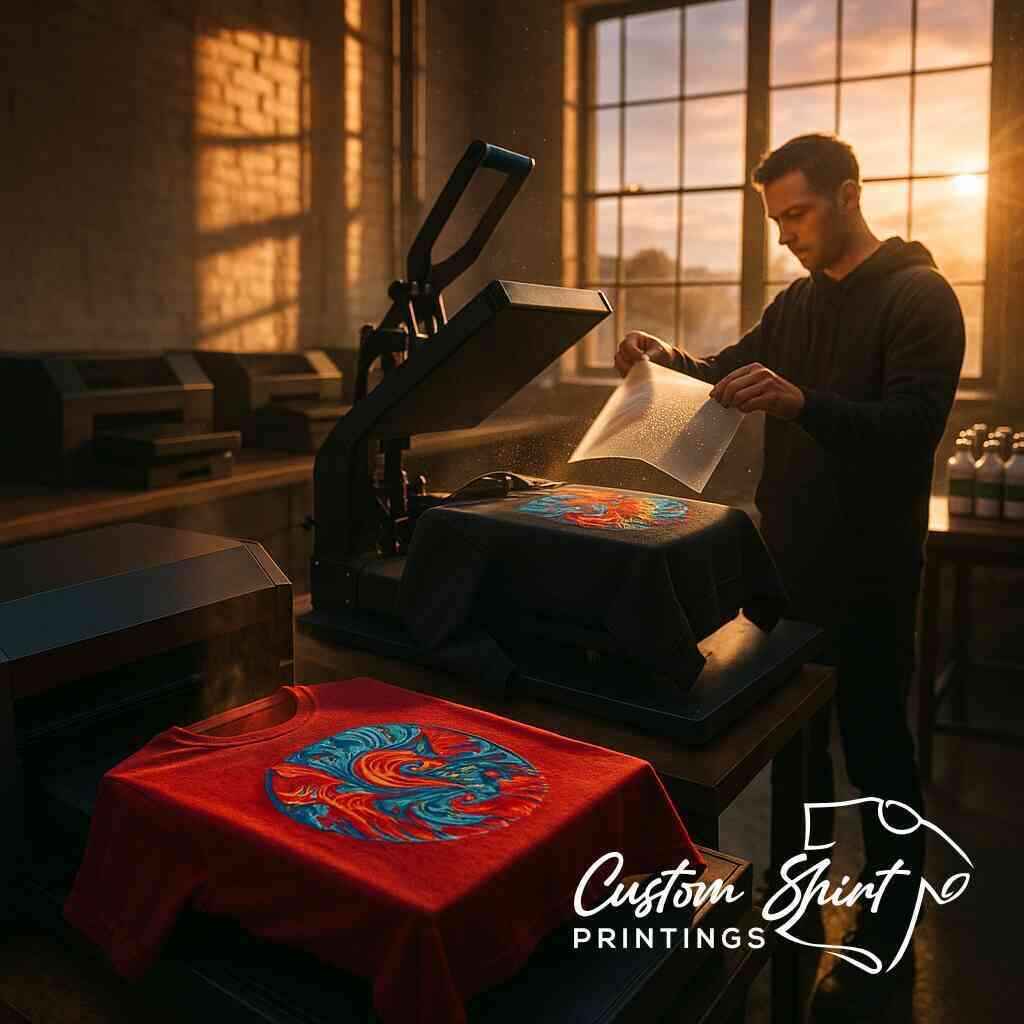
Direct-to-garment printing begins with meticulous pretreatment, priming each fiber for perfect adhesion. Technicians load your blank shirt, align it on the platen, and calibrate height within millimeters. A white underbase sprays first, giving dark garments a bright canvas for brilliant hues. CMYK micro droplets then layer photographically, guided by our color-managed RIP software. Heat presses lock pigments, creating soft, breathable art ready for wear or resale. For deeper explanations, explore our comprehensive 2026 DTG guide insights resource.
The magic happens inside industrial printheads firing droplets smaller than human hair widths. Our Long Island custom shirt printing facility maintains strict humidity so inks flow flawlessly. Color profiles match sRGB artwork, ensuring the t-shirt mockup and printing preview becomes reality. Automated platens travel smoothly, preventing ghosting that cheaper systems often introduce. Final infrared flashes fully cure ink without scorching cotton or compromising softness. Curious learners usually explore a range of printing techniques before touring our facility.
Cotton-powered color depth and soft-feel fabric prints
Nothing showcases DTG printing better than high-quality ringspun cotton absorbing rich pigment. The cellulose structure drinks ink, creating vibrant color t-shirt prints without heavy handfeel. Our proprietary pretreat melts into fibers, so custom tees remain breathable during summer adventures. Lab tests reveal deeper blacks and smoother gradients compared with generic stock garments. Discover additional optimization tips inside our top ten DTG secrets for vibrant prints feature.
Fabric selection also influences the longevity of custom t-shirt options at Custom Shirt Printings. We stock leading brands like Bella+Canvas, Next Level, Gildan, Comfort Colors, and Champion for a range of budgets. Each label offers a different knit density, affecting ink penetration and ultimate wash durability. Our designers guide you toward best cotton weight when planning logo shirt design services. For fundamentals around garment construction, our team gladly shares straightforward fabric education during consultations.
Small batch custom tees with no minimum order advantages
DTG excels when you need small-batch custom tees with no minimum order requirements. Artists can print single prototypes, evaluate color, then iterate without costly setup fees. This freedom helps local brands test markets across Long Island’s custom shirt printing landscapes. Coupled with our fast t-shirt delivery options near me, campaigns launch quickly after design approval. Seasonal pop-up shops, therefore, avoid dead inventory and cash flow nightmares. Each printed shirt carries retail-ready labels and fold packaging upon request.
Small runs also empower families ordering reunion graphics or teams updating numbers weekly. You choose DTG because color swaps happen inside software, not on physical screens. Custom Shirt Printings maintains cross-order consistency, ensuring every player or cousin shares identical tones. Our collaboration with Lead Marketing Strategies agency support amplifies artwork exposure after garments ship. Ultimately, DTG removes risk, letting you dream big while ordering only what you truly need.
Decoding DTF Printing Powder and Peel
Direct to film printing method walk through film to fabric
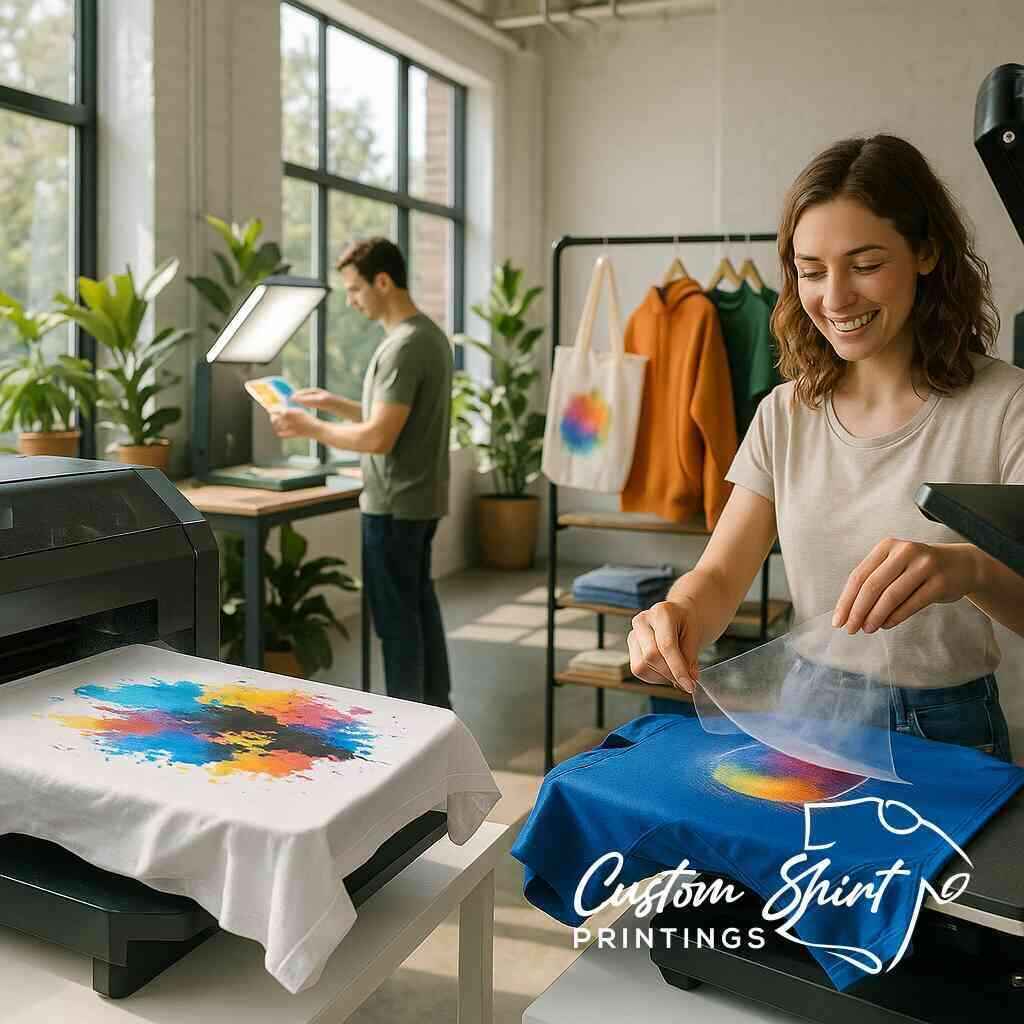
At our Commack facility, DTF printing begins long before fabric comes into contact with heat. Technicians load specialized PET film into precision feeders, maintaining tension for pixel-level accuracy. White ink lays a crisp base, followed by vibrant CMYK layers directed by calibrated software. Adhesive powder rapidly coats the wet design, ensuring a uniform bond across every pixel. Finally, a conveyor oven cures the powder, creating a transferable decal that outperforms older methods. For deeper visuals, explore our modern direct-to-film printing in the NY showcase.
Once the film cools, press operators align it onto cotton, polyester, or mixed garments with laser guides. A quick press at medium pressure liquefies the adhesive, locking pigment into every fiber channel. Peel happens when the temperature drops slightly, preventing ghost edges and preserving high-resolution garment prints. Because graphics rest above fibers rather than inside, the finish resists cracking while staying flexible. Unlike screen setups, this direct-to-film printing method handles gradients and microtext without extra cost.
Polyester and blended materials get vibrant color treatment
Critics long believed polyester muted saturation, yet new DTF chemistry flips that assumption on its head. Nano pigments encapsulated in flexible resin sit atop synthetic yarns, delivering vibrant color t-shirt prints never seen before. Even moisture-wicking gym shirts emerge from the press with photo-realism matching that of cotton posters. Local athletes searching for custom shirt printing near me feel the difference during high-heat workouts. Color brilliance remains consistent from blank to bleacher, satisfying fans across the expansive Long Island region.
Blended fabrics, combining cotton softness with polyester strength, often stump traditional screen operators. DTF overcomes that challenge because it adheres to both cellulose and polymer segments equally. The result is uniform gloss and tone, so custom hoodies look identical to matching tote bags. Moreover, eco-friendly fabric inks used by Custom Shirt Printings maintain breathability despite surface bonding. Consequently, the difference between DTG and DTF becomes clear when testing the same graphic across material spectra.
High volume apparel orders and scalable production speed
When event planners request thousands of pieces, DTF shines by separating print creation from garment curing. Operators stockpile finished films, then stage rapid press cycles on multiple heat stations simultaneously. This parallel workflow reduces idle time, slashing turnaround without inflating cost per print for businesses. Brands leveraging our custom apparel company often pair transfer runs with logo embroidery paired with DTG or DTF accents. The hybrid approach elevates perceived value while keeping budgets predictable across corporate gift programs.
Scalability also empowers pop-up shops to reorder popular designs overnight, avoiding disappointing fans during peak traffic. Because film stores flat, reprints skip the expensive recalibration, ensuring consistent Pantone matches month to month. Automated shuttles feed presses, maintaining throughput that rivals offshore factories yet retains Long Island accountability. Meanwhile, integrated quality cameras catch defects instantly, preserving the sustainability scorecards our clients demand. Ultimately, DTF gives Custom Shirt Printings the agility to fulfill high-volume apparel orders without sacrificing artistry.
DTG vs DTF Strategic Decision Matrix for Your Brand
Wash durability tests for DTG and DTF myth-busting
Independent labs submerged our DTG and DTF samples in 50 cold-water cycles, followed by tumble-dry sessions. Analysts measured color shift, handfeel, and fiber integrity after every tenth wash. Contrary to online myths, both methods retained over 95% of their vibrancy when treated according to care tags. DTG prints are bonded to cotton yarns, so the surface remains smooth rather than rubbery, even under aggressive testing. Meanwhile, DTF adhesive flexed without cracking, silencing critics who confuse it with older vinyl transfers.
Our technicians also performed stretch simulations that mirror gym movements and daily wear. DTG graphics stretched with the fabric, rebounding without visible fissures on ringspun tees. DTF overlays returned to shape as well, thanks to new elastic resins engineered for athletic polyester. Side-by-side microscopy proved that edge lift, not fading, causes most premature failures that people blame on ink chemistry. Understanding these micro mechanics empowers you to choose the optimal method with evidence rather than rumor.
Fade-resistant custom tees versus hard-wearing hoodies
Colorfastness depends on fabric density as much as print chemistry, so we tested Bella+Canvas tees against heavyweight Champion hoodies. DTG penetrated deep into the loops of cotton fleece, producing shadow-free gradients that looked almost airbrushed. After repeated machine drying, the hoodie graphics remained vivid because the bulkier yarns absorbed more pigment than the thinner jersey. Conversely, DTF on the same hoodies created a satin shield that repelled lint and abrasion during skate park trials. Customers wanting showroom brightness months later often prefer this surface armor.
On lightweight tees, DTG still delivers a buttery handfeel that fashion boutiques crave for upscale retail lines. Yet touring bands hauling gear nightly lean toward the scuff resistance of DTF, especially when printing backstage passes directly on shirts. Long Island custom shirt printing success stories show both approaches thriving side by side. Therefore, the decision matrix hinges on lifestyle: festival vibes favor DTG softness, while construction crews rely on DTF resilience. Our advisors help you balance these priorities so every garment tells your story season after season.
Cost per print and turnaround math for businesses
Budget planning begins with evaluating how many units you realistically need this quarter, not next year. DTG shines for on-demand custom apparel because files load instantly, and there are zero screen fees. When you reorder 20 firefighter shirts, setup takes minutes, keeping per-piece cost predictable even for micro-batches. DTF becomes cost-efficient at larger volumes because film can be stockpiled days in advance, reducing press downtime during peak rushes. Corporate buyers therefore alternate: DTG for pilot launches, DTF for nationwide rollouts.
Lead time differs too, especially when shipping beyond Commack in New York overview boundaries. DTG jobs often leave our facility the same day because curing integrates into printing. In contrast, DTF adds a transfer press phase, yet parallel stations offset that delay for bulk orders. Our spreadsheet tools model these timelines plus freight zones, letting accountants see the true landed cost per garment. Armed with transparent data, you choose print paths that protect cash flow while amplifying brand reach.
Sustainability scorecards, ink waste, and energy profiles
Eco-minded clients evaluate carbon and water footprints alongside aesthetics, so we track every milliliter of ink used per garment. DTG employs a closed-loop pretreatment system that recycles overspray, reducing waste by nearly 30%. Energy consumption stays low because infrared dryers cure pigment at targeted wavelengths rather than heating entire ovens. DTF counters use powder shakers calibrated to micrograms, ensuring adhesive coats only print pixels. Automated reclaim trays then collect unused powder for future passes, dramatically reducing landfill output.
Beyond production, we embed sustainability into marketing by pairing garments with digital business card QR code solutions that eliminate paper handouts. Brands share care instructions and recycling tips through a simple scan, extending the eco conversation long after checkout. Additionally, our partnership with Long Island recycling cooperatives ensures misprints never reach garbage streams; they become shop rags or art canvases instead. When you evaluate DTG versus DTF through this holistic lens, both deliver greener paths than legacy screen printing. Ultimately, Custom Shirt Printings lets you document these metrics for stakeholder reports, proving that style and stewardship can coexist beautifully.
Your Next Move in Custom Shirt Printing Mastery
Booking your design review and repair session in Commack
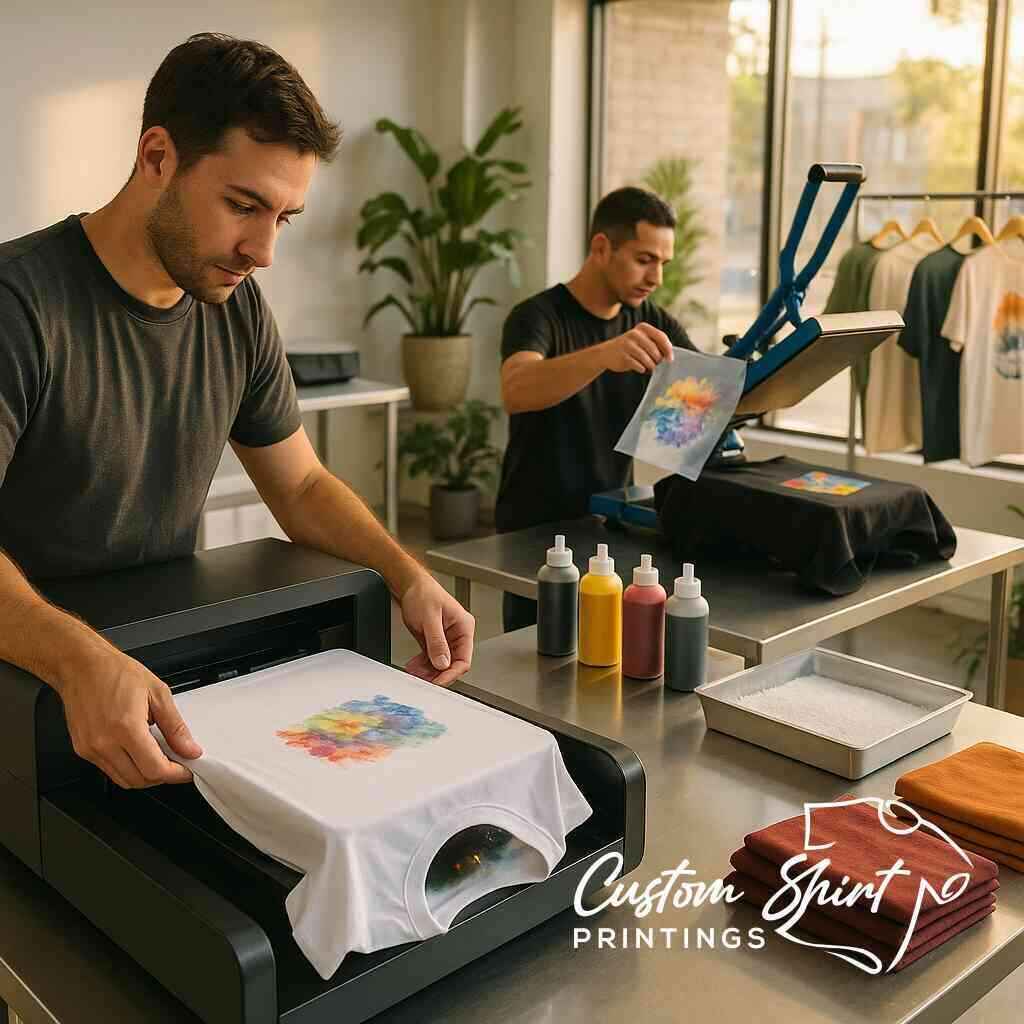
Custom Shirt Printings streamlines every creative step, beginning with a complimentary design review at our Commack showroom. You simply upload artwork or visit with sketches, and our technicians inspect stroke weight, resolution, and color profiles. This local advantage eliminates the back-and-forth many people face with distant vendors, keeping Long Island custom shirt printing personal and efficient. Because consultations take place in the same facility that prints, adjustments flow straight into production without costly delays. Customers searching for custom shirt printing near me quickly realize they are minutes from expert guidance rather than hours from uncertainty.
Securing an appointment takes just a few clicks through our intuitive portal, and you can still walk in if inspiration strikes suddenly. During the session, we preview mockups on Bella+Canvas or Champion blanks, letting you feel fabrics while examining on-screen Pantone matches. Our advisors explain pretreatment choices, ensuring custom t-shirt options maintain longevity even after strenuous gym sessions. They also flag potential embroidery zones, saving budget by combining methods before artwork locks. For newcomers who crave foundational knowledge, our team often references t-shirt apparel basics so design decisions rest on solid ground.
Pairing DTG or DTF with embroidery for hybrid branding
Businesses often request layered branding that feels high-fashion yet remains cost-effective for bulk uniforms. Our solution blends DTG or DTF base graphics with precision embroidery on chest crests, sleeves, or hat fronts. The printed layer delivers photo realism, while stitched accents add texture that shoppers perceive as premium. Because both departments operate under one roof, color threads coordinate perfectly with ink gradients, protecting brand consistency across custom hoodies and custom sweatshirts. Hybrid production also shortens timelines, allowing corporate teams to unveil cohesive collections without juggling multiple vendors.
Technical alignment is critical when merging methods, so we use laser grids to position appliqués to within fractions of a millimeter. DTG works beautifully on cotton fleece, whereas DTF dominates mixed polyester jackets; yet embroidery threads bind equally well to both substrates. Designers select thread sheen, stitch density, and backing materials, along with ink profiles, to ensure garments withstand industrial laundering. To deepen understanding, many clients explore direct-to-garment printing technology before approving final proofs, appreciating the science that secures wash durability. The result is merchandise that feels boutique while performing like athletic gear.
From digital business card QR code tees to web design branded shirts
Modern networking rarely involves paper, so we embed dynamic QR codes directly onto tees, hoodies, and tote bags. Scan-and-save technology routes prospects to portfolio pages, social feeds, or appointment calendars, turning every wearer into a roaming billboard. Our art department sizes codes for flawless smartphone recognition, even after hundreds of washes, testing each sample under varied lighting conditions. This interactive twist sets trade-show swag apart from generic giveaways and pairs perfectly with our no-minimum-order shirts strategy. Brands grow organically because every garment sparks measurable digital traffic.
Companies expanding their online presence often complement QR codes on apparel with cohesive website visuals. Our studio partners with web design and SEO on Long Island specialists, matching on-screen color palettes to physical merchandise hues. Unified branding increases recall, whether customers see your logo on a screen or at a farmers’ market stall. Designers share vector files across teams, so web banners, business cards, and embroidered caps refresh simultaneously. The synergy transforms a simple shirt into a full-funnel marketing asset managed entirely within the Long Island ecosystem.
Lead Marketing Strategies to launch your custom apparel drop
After samples impress internal stakeholders, the next challenge involves public buzz and measurable conversions. That’s where our collaboration with Lead Marketing Strategies amplifies momentum beyond traditional advertising. Their analysts craft social media calendars, influencer outreach, and geo-targeted ads tuned to retail or nonprofit goals. Meanwhile, our fulfillment software syncs inventory updates, preventing overselling when a post suddenly goes viral. Together, we turn limited runs into evergreen revenue streams, helping brands scale without sacrificing authenticity.
For entrepreneurs seeking networking leverage, we connect successful apparel clients with Long Island Business Network resources. Membership unlocks mentorship circles, vendor discounts, and exclusive pop-up opportunities across bustling hamlets. Custom Shirt Printings supplies the merchandise, while the network delivers foot traffic and industry insight. This dual approach accelerates brand maturity, allowing newcomers to stand alongside legacy labels at regional festivals. When strategy, technology, and community intersect, your next apparel drop becomes a story Long Island proudly wears.
Frequently Asked Questions
Question: What is the main difference between DTG printing and DTF printing and how do I decide which is better for my custom apparel order?
Answer: DTG printing (direct-to-garment) sprays eco-friendly fabric inks directly into cotton fibers, creating soft-feel fabric prints that breathe like the shirt itself. DTF printing (direct-to-film) first builds the graphic on a PET film, coats it with adhesive powder, and then heat-presses the design onto virtually any fabric, including polyester, blends, and performance gear. Choose DTG when you want on-demand, photo-realistic detail on cotton tees with no minimum order. Pick DTF when you need vibrant color t-shirt prints on mixed materials, or for large-volume apparel orders that must stay consistent across thousands of units. Our Long Island custom shirt printing advisors in Commack will examine your artwork, fabric choice, and deadline to recommend the perfect solution every time.
Question: How does Custom Shirt Printings ensure vibrant colors and long-term wash durability for both DTG and DTF methods?
Answer: For DTG, we pretreat every cotton garment in a humidity-controlled room, then fire micro-droplets through industrial heads that match your sRGB file exactly. The ink bonds inside the yarns, so colors remain vivid after 50+ cold cycles. With DTF, we cure adhesive powder precisely, creating a flexible resin shell that resists cracking on hoodies, custom sweatshirts, and tote bags. Independent labs confirmed less than 5 % fade for both processes, and we share those wash durability tests for DTG and DTF with any client who asks. Because everything happens in our Commack facility, you get local accountability plus global-level quality.
Question: I only need 10 tote bags and 1 prototype hoodie. Do you really offer small batch custom tees and fast turnaround with no minimum order?
Answer: Absolutely. DTG excels at small-batch custom tees, prototype runs, and personalized hoodie printing because there are no screens or films to set up. Order a single garment or mix styles (tees, tote bags, sweatshirts), and we will print, cure, and ship-often the same day-for customers searching for custom shirt printing near me on Long Island. Our t-shirt mockup and printing software show instant proofs, and every order receives a complimentary design review to keep your project on schedule and on budget.
Question: Can DTG and DTF prints handle polyester gym shirts as well as soft cotton tees? What fabrics do you stock in Commack?
Answer: DTG loves high-quality ringspun cotton, so we stock Bella+Canvas, Next Level, Gildan, Comfort Colors, and Champion in a range of weights. DTF, on the other hand, bonds well to polyester performance tees, blended hoodies, and nylon windbreakers because the adhesive adheres to both natural and synthetic fibers. That means the same logo shirt design can appear on cotton fan merch and moisture-wicking jerseys without color shift. Stop by our 1139-7 Jericho Tpk. showroom to feel samples and compare cotton versus polyester print quality in person.
Question: In the blog “What Is DTG vs DTF at Custom Shirt Printings Explained,” you mentioned eco-friendly fabric inks. How sustainable is your production compared to traditional screen printing?
Answer: Sustainability drives every step of our custom apparel company. DTG uses water-based, phthalate-free inks and an enclosed pretreat system that recycles overspray, reducing waste by 30%. DTF powder shakers reclaim unused adhesive for future prints, while low-energy ovens cure films at targeted temperatures. Compared with legacy screen printing, which can require gallons of water and chemical cleanup, our processes slash resource use and eliminate hazardous washes. We even partner with local recycling programs to turn misprints into shop rags, and we add digital business card QR code tees to reduce paper clutter at trade shows. When you choose Custom Shirt Printings, you get vivid art, fast turnaround, and a lighter footprint all at once.